Osteopathy: looking at the whole body to find where the pain comes from.
A way of looking at the whole body instead of only the spot that hurts. It is a six-year training taken after the physiotherapy degree, and very few practitioners in Ecuador hold it in full.
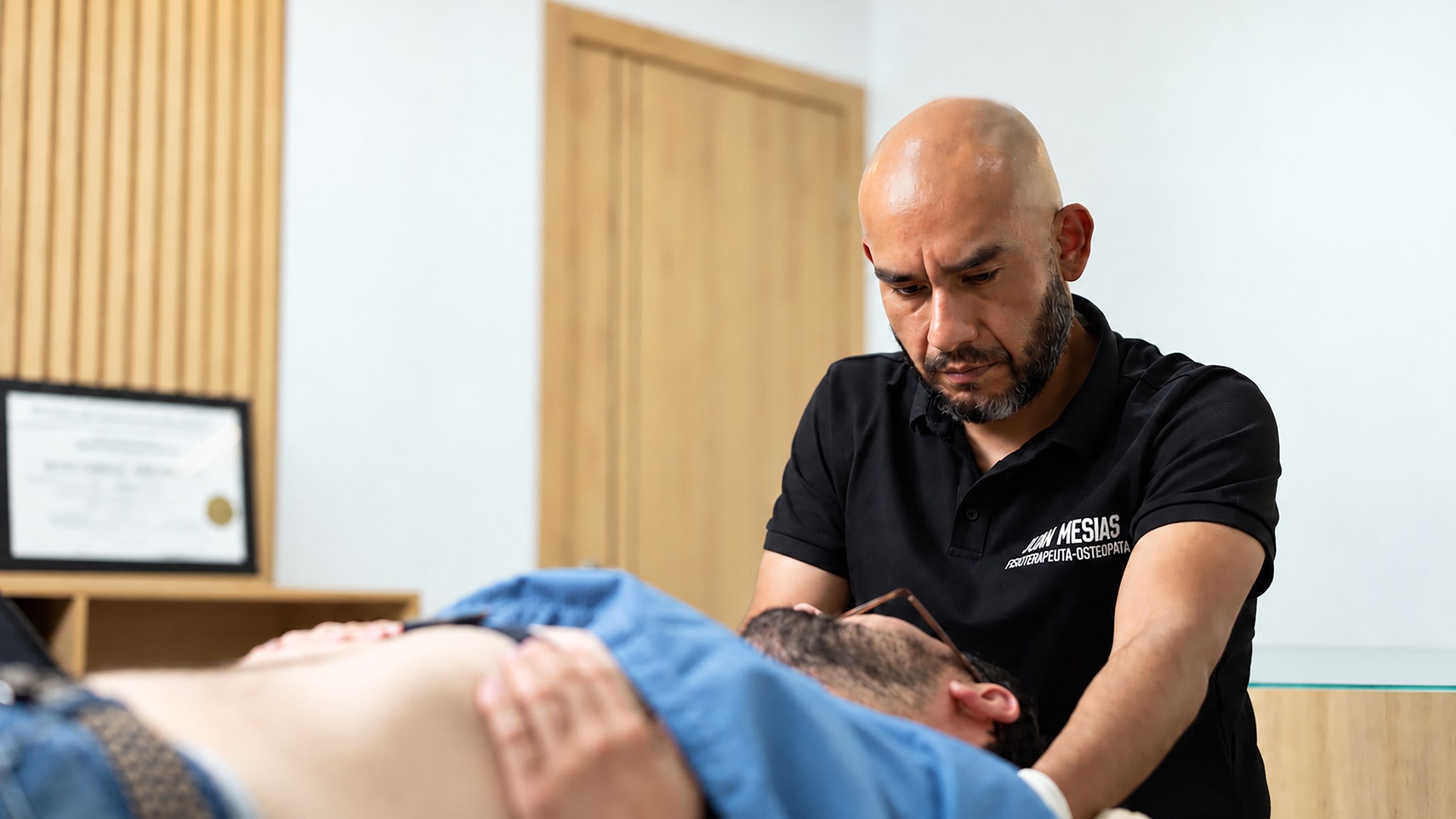
Pain is a symptom. When someone takes a blow, a cut or a fracture, you work where the problem is, because that is where the problem is.
But when pain has lasted more than three months, the cause is usually no longer where it hurts. Some pain is the reflection of something else, somewhere else.
Classical physiotherapy treats the segment that hurts. Osteopathy lets you go looking for the origin. That is the kind of patient Juan sees.
Why Juan's patients come to him.
Common reasons for consultation. These 35 reasons are all listed so that anyone looking for theirs can find it. They describe why people consult, not what a treatment guarantees.
Spine, neck and back
The pain that shows up when you bend, when you get out of a chair, or that doesn't ease lying down.
Assessment tests are used to identify the different alterations that can occur in the bones, muscles and ligaments, and so to establish the origin of various conditions.
Chronic non-specific low back pain
«low back pain that won't go away»
Disc herniation
«slipped disc»
Acute lumbosciatica
«back pain running down the leg»
Neck pain and whiplash
«neck pain, whiplash»
Mid-back pain
«pain between the shoulder blades»
Intercostal neuritis
Scoliosis
Shoulder, elbow and hand
Pain, tingling or loss of strength from the shoulder down to the fingers.
Carpal tunnel syndrome
«hands tingling at night»
Rotator cuff
«shoulder pain when raising the arm»
Lateral epicondylalgia
«tennis elbow»
Medial epicondylalgia
«golfer's elbow»
Hip and pelvis
What bothers you walking, climbing stairs, or sleeping on your side.
Hip osteoarthritis
Trochanteric pain
«pain on the side of the hip»
Bursitis
Groin pain
Iliotibial band syndrome
Knee, ankle and foot
What hurts going down stairs, or on the first step of the day.
Knee osteoarthritis
Patellar tendinitis
Patellofemoral syndrome
«pain at the front of the knee»
Knee sprain
Pes anserine syndrome
Ankle sprain
Plantar fasciitis
«heel pain when getting up»
Functional syndromes
Widespread or persistent pain where a local examination doesn't explain everything the person feels.
Fibromyalgia
«unexplained pain all over the body»
Irritable bowel syndrome
«irritable bowel»
Cranial osteopathy
Manual techniques on the skull and the craniosacral relationship. These are the presentations people consult about.
Manual techniques are used to release and ease arterial and venous flow in the skull, and the craniosacral relationship as a whole, through the meningeal membranes — the dura mater — and the cerebrospinal fluid.
Postural alterations, trauma, muscular imbalance or cranial congestion can affect the cranial nerves, arteries and other tissues as they pass through the cranial openings or in their immediate surroundings.
Headaches
«constant headache»
Migraines
«migraine that keeps coming back»
Vertigo
Neck pain of cranial origin
Craniomandibular syndrome (TMJ) and bruxism
Neuralgia, for example trigeminal
Visceral osteopathy
Work on the tissues and membranes that let organs, vessels and nerves glide past one another. Reasons for consultation, not medical indications.
It addresses the tissues responsible for visceral function and the aponeurotic membranes that cover them and allow organs, blood vessels and nerves to glide past one another.
All of those tissues should be free along their anatomical path, which is not always the case: there can be adhesions from surgical or caesarean scars, or myofascial traction from postural disorders.
Those adhesions hinder or prevent the normal mobility of the viscera, and can be a source of pain referred to other parts of the body. Osteopathic manual techniques help release those interruptions in mobility.
Adhesions from surgical or caesarean scars
Myofascial traction from postural disorders
Pain referred to other parts of the body
Congestive syndromes at the peritoneal level
Osteopathy and physiotherapy do not replace medical diagnosis or treatment. Where there is an underlying condition, Juan refers the patient to the appropriate specialist.
Book a session