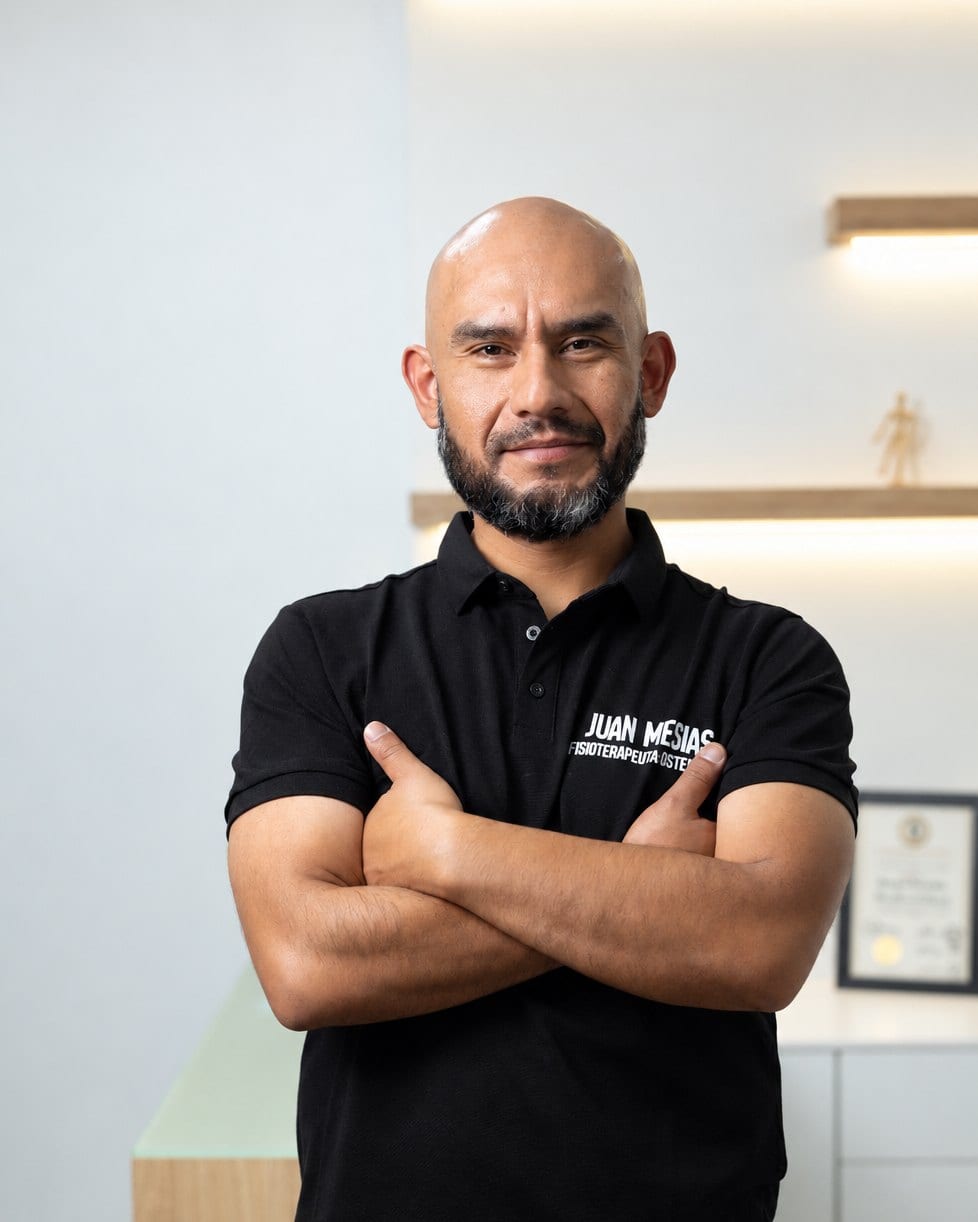
Juan Mesías
Registered physiotherapist with postgraduate specialisation in osteopathy.
My professional path has been about combining experience with scientific evidence to offer treatments of high clinical efficiency.
The Juan Mesías osteopathy and physiotherapy practice was built on understanding clinical work as a process of thorough analysis.
My aim is not to apply generic treatment protocols, but to assess each patient carefully in order to design personalised, safe interventions that meet current health regulations.
Eleven years of training before laying on hands.
- 2020
Certified osteopath
Escuela de Osteopatía de Madrid
A qualification that requires a physiotherapy degree for admission. Six years of formal training.
- 2016
Master's in Osteopathic Techniques for the Locomotor System
Escuela de Osteopatía de Madrid · Universidad Pontificia de Salamanca
University postgraduate degree focused on the musculoskeletal system.
- 2008
Bachelor's in Physiotherapy
Universidad Técnica de Ambato
Five years of university training. It is the degree that made everything after it possible.
- 17
Clinical practice· 17 years
A practice focused on long-standing pain, in Quito.
The school where Juan trained requires a physiotherapy degree just to apply. There is no way in without it.
This matters because there are courses out there lasting a weekend, two weekends, a month, handing out certificates in «chiropractic techniques» or «osteopathic massage». They are not the same thing, and the patient does not notice the difference until they are already on the table.
Osteopathy is a profession with formal academic training. Very few practitioners in Ecuador hold both qualifications in full, and Juan belongs to the country's first generation of osteopaths.
Certifications.
- 2026Diagnosis and clinical reasoning of the autonomic nervous systemInstituto de Salud Neurofuncional Avanzada · Madrid, Spain
- 2013Dry Needling and Manual Therapy for Trigger Point · Top 30D. G. Simons Academy · Santiago, Chile
- 2013Electrical stimulation for trigger points (IES / IMES) · Dry Needling and Trigger Point TherapyD. G. Simons Academy · Santiago, Chile
- 2013Mountain sportsClínica MEDS · Médico-deportivas y Ciencias del Ejercicio · Santiago, Chile
- 2011KT TapeQuito
- 2009Musculoskeletal acupunctureQuito
How he works.
The most common case: someone who has already had surgery or completed a full course of physiotherapy, was discharged, and still hurts.
Physiotherapist and osteopath
Very few practitioners in Ecuador hold both qualifications in full, and Juan belongs to the country's first generation of osteopaths. Physiotherapy treats the segment that hurts; osteopathy asks why it hurts. Holding both means asking both questions in the same session.
Eleven years of training
Five years of physiotherapy at Universidad Técnica de Ambato and six of osteopathy at the Escuela de Osteopatía de Madrid, with a master's from Universidad Pontificia de Salamanca in between. This is not a weekend course.
The session belongs to one person
Juan never sees several patients at once. There are no shared rooms and no time split between tables. The whole block belongs to whoever booked it.
He assesses first, and refers out when it isn't his case
If the assessment turns up something that belongs to another professional, Juan says so and refers. Pain of cardiac origin goes to a cardiologist; a migraine coming from a dental infection goes to the dentist. He does not take a case just to take it.
What people ask before coming in.
What is osteopathy?
It is a therapeutic discipline that uses assessment tests, an accurate diagnosis and manual techniques to correct dysfunctions that may be affecting the body's different systems: musculoskeletal, cranial, visceral and the autonomic nervous system. Its main aim is to treat the patient as a whole.
Is osteopathy painful?
Osteopathy should not be a painful technique. Used by a qualified and properly certified practitioner, its aim is to relieve the patient's pain safely and non-invasively.
What difference does it make that you are both a physiotherapist and an osteopath?
The main benefit is your safety and the effectiveness of the treatment. My training as a physiotherapist and as an osteopath means you are in the hands of a healthcare professional with official university qualifications, and they let me go beyond the local symptom to find the real origin of pain that other treatments have not resolved.
What is the first consultation like?
It starts with a detailed clinical interview about your health history and habits. Then I carry out a full physical assessment; if there are imaging studies, they are reviewed and compared against the patient's actual condition. Finally the diagnosis is built.
How does intramuscular stimulation work?
Thin acupuncture needles are inserted into the belly of the muscle. The practitioner looks for taut muscle bands or trigger points pressing on a peripheral nerve; as the needle enters, the muscle produces an involuntary reflex contraction that forces it to release its accumulated tension. A low-frequency electrical device may then be used to enhance endorphin release and reduce the nerve's hypersensitivity.
Why use intramuscular electrical stimulation?
Because it reaches tissues and muscles that manual therapy and conventional massage cannot.
How much does a session cost?
A session costs 40 dollars. It is the same price for the first consultation and for every treatment session. If your case needs a longer plan, a package is arranged with a discount for advance payment.
How long does it last?
One hour. There is a gap between one patient and the next, so nobody leaves in a rush and there is time for whatever questions come up at the end.
Will I be treated at the first appointment?
The first appointment is consultation and assessment: clinical history, review of any scans you bring, and a full physical evaluation. That takes the whole hour, so treatment begins from the second session.
How many sessions will I need?
It depends on the case, and it cannot be known before seeing it. After the first assessment Juan tells you what he found and what he expects from the process. If he thinks he cannot help you, he says that too, and refers you to whoever can.
What if I can't make my appointment?
Let us know at least four hours in advance so the slot can be offered to another patient. You get a reminder before the appointment so it doesn't slip by.
What if my case isn't one for osteopathy?
Juan tells you. The assessment may turn up something that belongs to another professional, and in that case he refers you: to a cardiologist, a dentist, whoever it should be. He does not take a case just to take it.
Do you make home visits?
No. Care is provided only at the practice.
How far ahead do I need to book?
2 hours is enough. If there is a free slot the same day, you can take it: there is no need to wait until next week.
Osteopathy and physiotherapy do not replace medical diagnosis or treatment. Where there is an underlying condition, Juan refers the patient to the appropriate specialist.
Book a session